NOTE / 4/30/2019
[LiDAR SLAM] A Simple K-Means Implementation
K-means is a clustering algorithm. This article provides a simple implementation.
K-means animation:
https://www.zhihu.com/video/1106986187683876864
Problem statement
Given data points , each of dimension , K-means partitions the points into clusters, . It minimizes the total squared distance from each point to its cluster center:
See the Wikipedia article on K-means clustering for a detailed introduction.
K-means algorithm
- Input: a set of points and the number of clusters . Output: a cluster assignment for every point.
- Randomly select points as the initial means.
- Assign every point to its nearest mean by Euclidean distance.
- Recalculate the mean of every cluster.
- Stop when assignments, total cost, or means no longer change.
K-means does not necessarily find the global optimum.
Implementation
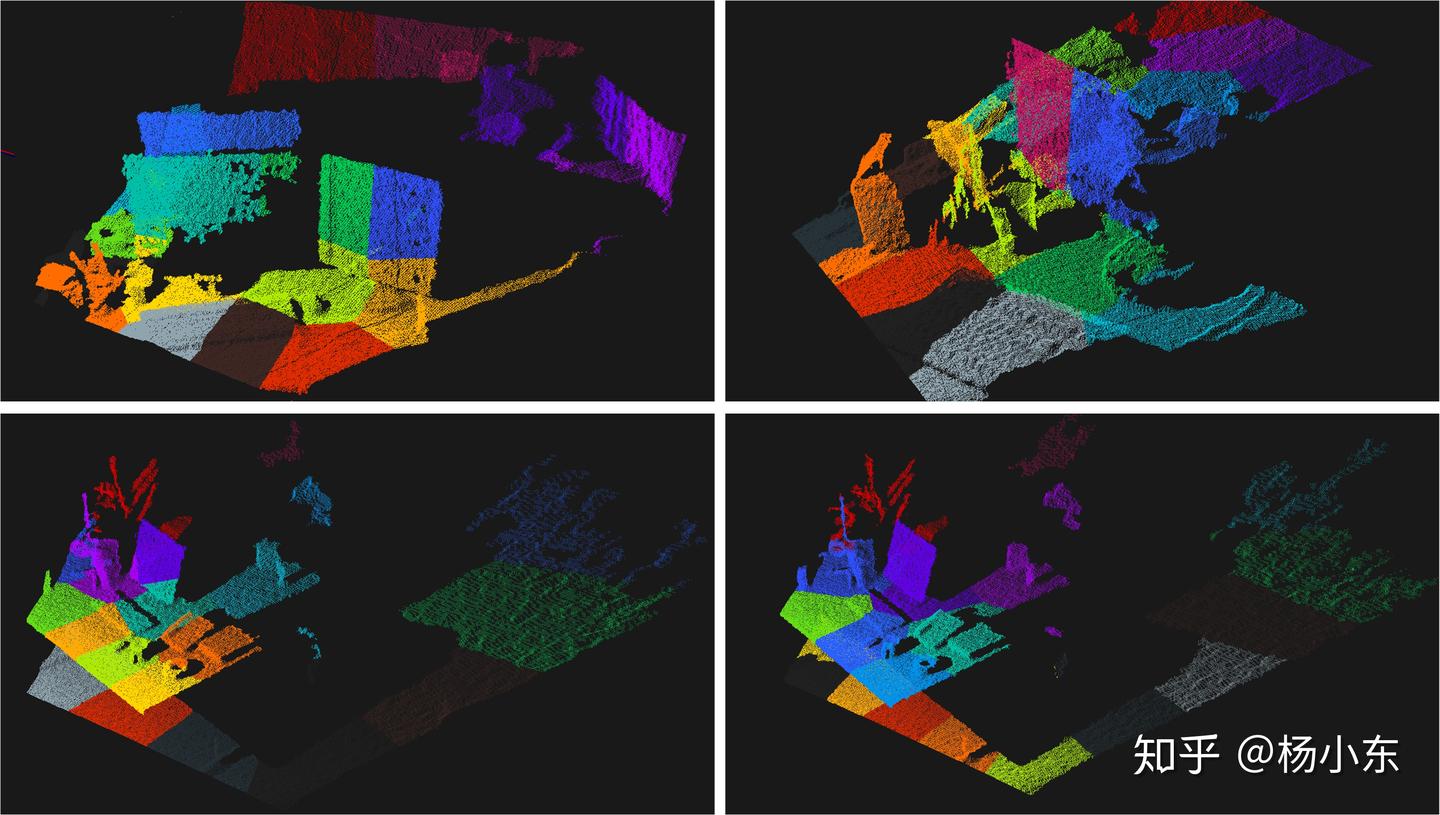
The full source is below. A depth image from the TUM RGB-D data set is converted to a 3D point cloud and segmented with K-means.
void Kmeans::clustering ( const std::vector< Eigen::Vector3d >& point_cloud, int k, int max_iters, double epsilon, std::vector< int >& classes )
{
    if ( point_cloud.size() < k ) {
        return;
    }
    // classes.reserve ( point_cloud.size() );
    // classes.shrink_to_fit();
    classes = std::vector<int> ( point_cloud.size(), 0 );

    // Step 1: randomly select k points. TODO
    std::vector<Eigen::Vector3d> means; // means for k clusters
    means.reserve ( k );

    cv::RNG rng ( cv::getTickCount() );
    std::set<int> selected_ids;
    while ( selected_ids.size() < k ) {
        int id = rng.uniform ( 0, point_cloud.size() );
        if ( ! selected_ids.count ( id ) ) {
            selected_ids.insert ( id );
        }
    } // selected IDs
    std::set<int>::const_iterator iter;
    for ( iter = selected_ids.begin(); iter != selected_ids.end(); ++iter ) {
        means.push_back ( point_cloud.at ( *iter ) );
    }

    // Start iterations
    for ( size_t nit = 0; nit < max_iters; ++nit ) {
        // Step 2: assign points to clusters.
        // For each point
        for ( size_t i = 0; i < point_cloud.size(); i ++ ) {
            // Point.
            const Eigen::Vector3d& pt = point_cloud.at ( i );

            // Initialize parameters
            int min_class_id = -1;
            double min_dist = std::numeric_limits<double>::max();

            for ( size_t j = 0; j < k ; j ++ ) {
                const Eigen::Vector3d& mean = means.at ( j );
				double dist = ( pt-mean ).norm(); // Euclidean distance
                if ( dist < min_dist ) {
                    min_dist = dist;
                    min_class_id = j;
                }
            }

            classes.at ( i ) = min_class_id; // Assign cluster ID.
        } // Assign every point to its nearest cluster.

        // Step 3: compute a new center for each cluster.
        std::vector<Eigen::Vector3d> new_means ( k, Eigen::Vector3d ( 0.0,0.0,0.0 ) ); // Accumulate for each cluster
        std::vector<int> npts_class ( k, 0 ); // number of points in each cluster
        for ( size_t i = 0; i < point_cloud.size(); i ++ ) {
            // Point
            const Eigen::Vector3d& pt = point_cloud.at ( i );
            const int& class_id = classes.at ( i );

            // sum
            new_means.at ( class_id ) += pt;
            npts_class.at ( class_id ) ++;
        }

        for ( size_t i = 0; i < k; i ++ ) {
            new_means.at ( i ) /= ( double ) ( npts_class.at ( i ) );
        }

        // Step 4: check convergence
        double delta_mean = 0.0;
        for ( size_t i = 0; i < k; i ++ ) {
            delta_mean += ( new_means.at ( i ) - means.at ( i ) ).norm();
        }

        if ( delta_mean < epsilon ) {
            break;
        }

        // Copy centers.
        means = new_means;
    } // max iterations.

} //  clustering
Full project, including the test code