NOTE / 9/5/2018
[PR-2] Particle Filter / Monte Carlo Localization
Probabilistic Robotics (PR) is a classic introduction to mobile robotics. It focuses primarily on theory and supplies pseudocode rather than implementations. This PR series recreates selected methods from my own understanding.
This article describes particle-filter localization on a grid map. The map is known in advance and was built with gmapping.
Particle-filter localization video
1. Algorithm flow
Chapter 8 of Probabilistic Robotics covers the underlying theory.
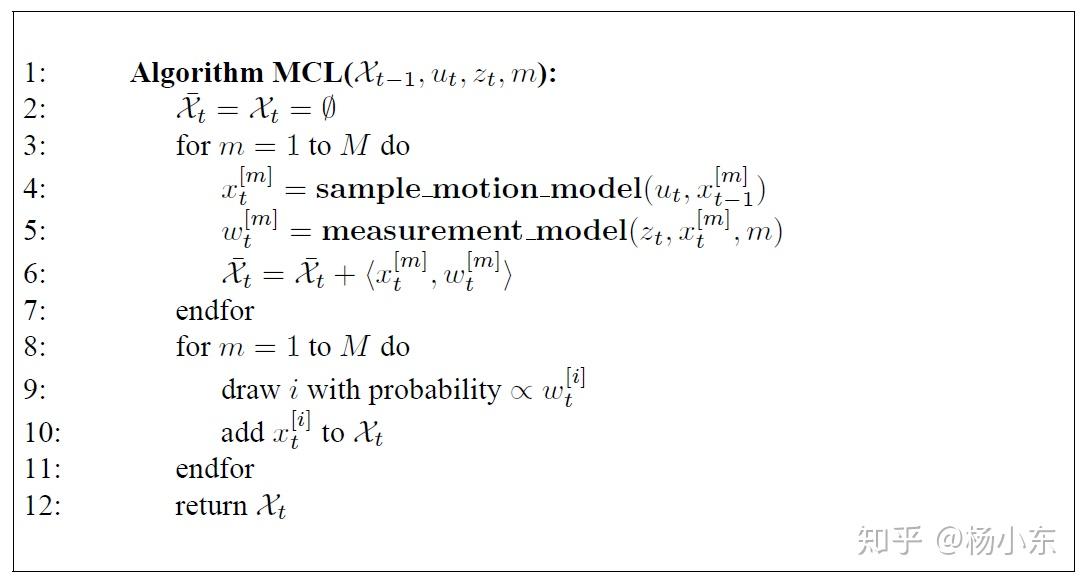
The algorithm has two key stages:
- Update particles.
- Resample particles.
2. Particle update
Particle update needs a motion model and a measurement model.
Motion model
The motion model is the Chapter 5 odometry sampling algorithm, sample_motion_model_odometry. Its input comes from the difference between two odometry poses. The textbook form does not account for pure rotation or reverse driving, so the implementation adds explicit handling for both.
#include <particle_filter_localization/motion_model.h>

MotionModel::MotionModel ( const double& alpha1, const double& alpha2, const double& alpha3, const double& alpha4 ):
alpha1_(alpha1), alpha2_(alpha2), alpha3_(alpha3), alpha4_(alpha4)
{
    rng_ = cv::RNG(cv::getTickCount());
}

void MotionModel::sampleMotionModelOdometry ( const double& delta_rot1, const double& delta_trans, const double& delta_rot2, Pose2d& xt )
{
    /* Handle reverse motion */
    double delta_rot1_PI = delta_rot1 - PI;
    double delta_rot2_PI = delta_rot2 - PI;
    Pose2d::NormAngle(delta_rot1_PI);
    Pose2d::NormAngle(delta_rot2_PI);
    double delta_rot1_noise = std::min(fabs(delta_rot1), fabs( delta_rot1_PI) );
    double delta_rot2_noise = std::min(fabs(delta_rot2), fabs( delta_rot2_PI) );

    double delta_rot1_2 = delta_rot1_noise*delta_rot1_noise;
    double delta_rot2_2 = delta_rot2_noise * delta_rot2_noise;
    double delta_trans_2 = delta_trans * delta_trans;

    /* Sample */
    double delta_rot1_hat = delta_rot1 - rng_.gaussian(alpha1_ * delta_rot1_2 + alpha2_ * delta_trans_2);
    double delta_trans_hat = delta_trans - rng_.gaussian(alpha3_ * delta_trans_2 + alpha4_ * delta_rot1_2 + alpha4_ * delta_rot2_2);
    double delta_rot2_hat = delta_rot2 - rng_.gaussian(alpha1_ * delta_rot2_2 + alpha2_ * delta_trans_2);

    xt.x_ += delta_trans_hat * cos( xt.theta_ + delta_rot1_hat );
    xt.y_  += delta_trans_hat * sin( xt.theta_ + delta_rot1_hat );
    xt.theta_ +=  (delta_rot1_hat + delta_rot2_hat);
    xt.NormAngle(xt.theta_);
}
The four noise parameters should ideally be estimated statistically. Here they are set directly. Larger values indicate less trustworthy odometry and make particles diverge more readily during prediction.
Motion update
void Localizer::motionUpdate ( const Pose2d& odom )
{
    const double MIN_DIST = 0.02; // TODO param 如果运动太近的话就不更新了,防止出现角度计算错误
    if ( !is_init_ ) //First update
    {
        last_odom_pose_ = odom;
        is_init_ = true;
        return;
    }

    /* Compute u_t */
    double dx = odom.x_ - last_odom_pose_.x_;
    double dy = odom.y_ - last_odom_pose_.y_;
    double delta_trans = sqrt ( dx * dx + dy * dy );
    double delta_rot1 = atan2 ( dy,  dx ) - last_odom_pose_.theta_;
    Pose2d::NormAngle ( delta_rot1 );
    /* Handle pure rotation */
    if(delta_trans < 0.01)
        delta_rot1 = 0;
    double delta_rot2 = odom.theta_ - last_odom_pose_.theta_ - delta_rot1;
    Pose2d::NormAngle ( delta_rot2 );
    /* Update every particle */
    for ( size_t i = 0; i < nParticles_; i ++ )
    {
        motion_model_->sampleMotionModelOdometry ( delta_rot1, delta_trans, delta_rot2, particles_.at ( i ).pose_ ); // for each particle
    }

    last_odom_pose_ = odom;
}
Measurement model
The measurement model is the Chapter 6 likelihood-field range-finder model, likelihood_field_range_finder_model.
For speed, the likelihood field is precomputed. The parameter strongly affects convergence and can be chosen from lidar and map accuracy; this implementation uses .
#include <particle_filter_localization/measurement_model.h>
#define PI 3.1415926

MeasurementModel::MeasurementModel ( GridMap* map, const double& sigma, const double& rand ):
map_(map), sigma_(sigma), rand_(rand)
{
    /* Initialize the likelihood field; its cells are half the occupancy-grid cell size */
    size_x_ = 2 * map->size_x_;
    size_y_ = 2 * map->size_y_;
    init_x_ = 2 * map->init_x_;
    init_y_ = 2 * map->init_y_;
    cell_size_ = 0.5 * map->cell_size_;

    likelihood_data_.resize(size_x_ , size_y_);
    likelihood_data_.setZero();

    /* Build a KD-tree for obstacles */
    pcl::PointCloud<pcl::PointXY>::Ptr cloud (new pcl::PointCloud<pcl::PointXY>);

    for(int i = 0; i < map->size_x_;  i ++)
        for(int j = 0; j < map->size_y_; j ++)
        {
            if(map->bel_data_(i, j) == 1.0) //Add obstacle cells to the KD-tree
            {
                pcl::PointXY pt;
                pt.x = (i - map->init_x_) * map->cell_size_;
                pt.y = (j - map->init_y_) * map->cell_size_;
                cloud->push_back(pt);
            }
        }
    kd_tree_.setInputCloud(cloud);

    /* Compute likelihood for every cell */
    for(double i = 0; i < size_x_; i += 0.9)
        for(double j = 0; j < size_y_; j +=0.9)
        {
            /* Compute x and y */
            double x = ( i - init_x_)* cell_size_;
            double y = ( j- init_y_ ) * cell_size_;
            double likelihood =  likelihoodFieldRangFinderModel(x, y);
            setGridLikelihood(x, y, likelihood);
        }
}

double MeasurementModel::likelihoodFieldRangFinderModel ( const double& x, const double& y )
{
    /* Find the nearest distance */
    pcl::PointXY search_point;
    search_point.x = x;
    search_point.y = y;
    std::vector<int> k_indices;
    std::vector<float> k_sqr_distances;
    int nFound =  kd_tree_.nearestKSearch(search_point, 1, k_indices, k_sqr_distances);
    double dist = k_sqr_distances.at(0);

    /* Gaussian + random */
    return gaussion(0.0, sigma_, dist) + rand_;
}

double MeasurementModel::gaussion ( const double& mu, const double& sigma, double x)
{
    return (1.0 / (sqrt( 2 * PI ) * sigma) ) * exp( -0.5 * (x-mu) * (x-mu) / (sigma* sigma) );
}

bool MeasurementModel::getIdx ( const double& x, const double& y, Eigen::Vector2i& idx )
{
    int xidx = cvFloor( x / cell_size_ ) + init_x_;
    int yidx  = cvFloor( y /cell_size_ )+ init_y_;

    if((xidx < 0) || (yidx < 0) || (xidx >= size_x_) || (yidx >= size_y_))
        return false;
    idx << xidx , yidx;
    return true;
}

double MeasurementModel::getGridLikelihood ( const double& x, const double& y)
{
    Eigen::Vector2i idx;
    if(!getIdx(x, y, idx))
        return rand_;
    return likelihood_data_(idx(0), idx(1));
}

bool MeasurementModel::setGridLikelihood ( const double& x, const double& y, const double& likelihood )
{
    Eigen::Vector2i idx;
    if(!getIdx(x, y, idx))
        return false;
    likelihood_data_(idx(0), idx(1)) = likelihood;
    return true;
}

cv::Mat MeasurementModel::toCvMat()
{
    /* Construct an OpenCV-format image */
    cv::Mat map(cv::Size(size_x_, size_y_), CV_64FC1, likelihood_data_.data(), cv::Mat::AUTO_STEP);
    /* Flip */
    cv::flip(map, map, 0);
    return map;
}
Measurement update
Every particle evaluates all laser beams to obtain its weight. This implementation adds likelihoods rather than multiplying them, because direct multiplication converges too quickly. Resampling is invoked from measurement update, but only periodically: frequent resampling quickly causes particle degeneracy. Augmented MCL plus KLD sampling would be preferable; this version uses the simplest resampling approach.
void Localizer::measurementUpdate ( const sensor_msgs::LaserScanConstPtr& scan )
{
    if ( !is_init_ )
    {
        return;
    }

    /* Read laser data */
    const double& ang_min = scan->angle_min;
    const double& ang_max = scan->angle_max;
    const double& ang_inc = scan->angle_increment;
    const double& range_max = scan->range_max;
    const double& range_min = scan->range_min;

    for ( size_t np = 0; np < nParticles_; np ++ )
    {
        Particle& pt = particles_.at ( np );
        /* for every laser beam */
        for ( size_t i = 0; i < scan->ranges.size(); i ++ )
        {
            /* Read this beam range */
            const double& R = scan->ranges.at ( i );
            if ( R > range_max || R < range_min )
                continue;

            double angle = ang_inc * i + ang_min;
            double cangle = cos ( angle );
            double sangle = sin ( angle );
            Eigen::Vector2d p_l (
                R * cangle,
                R* sangle
            ); //Coordinates in the laser frame

            /* Transform to the world frame */
            Pose2d laser_pose = pt.pose_ * robot_->T_r_l_;
            Eigen::Vector2d p_w = laser_pose * p_l;

            /* Update weight */
            double likelihood = measurement_model_->getGridLikelihood ( p_w ( 0 ), p_w ( 1 ) );

            /* Sum laser-beam likelihoods; multiplication converges too quickly */
            pt.weight_ += likelihood;
        }// for every laser beam
    } // for every particle

    /* Normalize weights */
    normalization();

    /* TODO 这里最好使用书上的Argument 的重Sample + KLD重Sample方法.
     *重Sample频率太高会导致粒子迅速退化*/
    static int cnt = 0;
    if ( ( cnt ++ ) % 10 == 0 ) //减少重Sample的次数
        reSample();    //重Sample
}
3. Resampling
The implementation uses basic low-variance resampling. It requires a large number of particles for reliable localization. A fuller implementation could add Augmented MCL and KLD-sampling MCL from the book.
void Localizer::reSample()
{
    if ( !is_init_ )
        return;

    /* 重Sample */
    std::vector<Particle> new_particles;
    cv::RNG rng ( cv::getTickCount() );
    long double inc = 1.0 / nParticles_;
    long double r = rng.uniform ( 0.0, inc );
    long double c = particles_.at ( 0 ).weight_;
    int i = 0;

    for ( size_t m = 0; m < nParticles_; m ++ )
    {
        long double U = r + m * inc;
        while ( U > c )
        {
            i = i+1;
            c = c + particles_.at ( i ).weight_;
        }
        particles_.at ( i ).weight_ = inc;
        new_particles.push_back ( particles_.at ( i ) );
    }
    particles_ = new_particles;
}
4. ROS node
void odometryCallback ( const nav_msgs::OdometryConstPtr& odom )
{
    /* Read robot pose */
    double x = odom->pose.pose.position.x;
    double y = odom->pose.pose.position.y;
    double theta = tf::getYaw ( odom->pose.pose.orientation );
    Pose2d rpose ( x, y, theta );

    /* Motion update */
    g_localizer->motionUpdate ( rpose );

    /* Publish particles */
    geometry_msgs::PoseArray pose_array;
    g_localizer->particles2RosPoseArray ( pose_array );
    g_particles_puber.publish ( pose_array );

}

void laserCallback ( const sensor_msgs::LaserScanConstPtr& scan )
{
    /* Measurement update */
    g_localizer->measurementUpdate ( scan );

    /* Publish map at a lower frequency */
    static int cnt = 0;
    if( (cnt ++) % 100 == 0)
    {
        nav_msgs::OccupancyGrid occ_map;
        g_map->toRosOccGridMap ( "odom", occ_map );
        g_map_puber.publish ( occ_map );
    }
}
At initialization, poses are assumed uniformly distributed over the map. Moving from that uniform distribution to a converged estimate requires many particles.
Localizer::Localizer ( Robot* robot, GridMap* map, MotionModel* motion_model, MeasurementModel* measurement_model , size_t nParticles ) :
    robot_ ( robot ), map_ ( map ), motion_model_ ( motion_model ), measurement_model_ ( measurement_model ),nParticles_ ( nParticles )
{
    is_init_ = false;

    /* Initialize particles */
    const double minX = map->minX();
    const double maxX = map->maxX();
    const double minY = map->minY();
    const double maxY = map->maxY();
    cv::RNG rng ( cv::getTickCount() );
    size_t N = 0;
    double weight = 1.0 / nParticles;
    while ( N < nParticles )
    {
        double x = rng.uniform ( minX, maxX );
        double y = rng.uniform ( minY, maxY );
        double th = rng.uniform ( -PI, PI );

        /* Check map bounds and traversability */
        double bel;
        if ( !map->getGridBel ( x, y, bel ) )
        {
            continue;
        }
        if ( bel != 0.0 ) //0.0 denotes a traversable cell
        {
            continue;
        }

        /* Construct a particle */
        N++;
        Particle pt ( Pose2d ( x, y, th ), weight );
        particles_.push_back ( pt );
    }
}
Source and dataset
- Complete project: ydsf16/particle_filter_localization
- Lidar dataset: Baidu Netdisk